Credit Card Cash Advance Calculator
Need Cash Now? Know What You’ll Owe Before You Withdraw.
Our free credit card cash advance calculator shows how much emergency cash could really cost you. Before you withdraw, check the upfront fees, daily interest and how much you’ll need to repay — so today’s financial emergency doesn’t become next payday’s problem.
Find out what you could owe, compare repayment dates and check whether you’ll have enough cash to repay.
 By Harry P. · Founder & Editor
Updated 25 Nov 2026 · Educational estimate

Free credit card cash advance calculator
Enter the amount you want to withdraw, your card’s cash advance fee and APR, and when you expect the advance to be fully repaid. All amounts are in US dollars.
No bank login. Your numbers are calculated on this page; local saving and analytics are optional.See what the withdrawal really costs
Compare the cash you receive with the fees, interest and amount you would need to repay. Your results will appear here.
A fee can make even a short cash advance expensive. Paying sooner may reduce interest, but it does not undo an upfront fee.
Your estimated borrowing cost
Estimated total borrowing cost at different repayment dates, assuming no interim payments.
How much does a credit card cash advance cost?
A cash advance on a credit card lets you borrow cash against your credit limit rather than pay a merchant directly. The total cost depends on the amount, the transaction fee, the cash advance APR and how long the balance stays unpaid. It may also include an ATM operator’s fee.
Suppose you need cash for a repair and your card charges 5% or $10, whichever is higher. A $100 withdrawal costs $10 in issuer fees, not $5. A $500 withdrawal costs $25. That fee exists before any interest is calculated. This is why looking only at the APR can underestimate the short-term cost.
Use our free cash advance fee calculator above to compare the fee against the amount you actually receive. The CFPB’s guidance on ATM withdrawals also explains why a cash advance can have a separate limit and different interest terms.
Where to find your credit card cash advance fee and APR
You do not need to guess your borrowing costs. Open your card issuer’s app, latest statement or cardholder agreement. Look for these four details before entering numbers:
If your agreement is unclear about interest on fees or the daily rate basis, contact the issuer using the number on your card. You can compare both fee-interest settings while you confirm the terms.
Cash advance fee and interest examples
These examples use hypothetical card terms: 29.99% APR, a fee of 5% or $10 (whichever is higher), no additional ATM fee, interest charged on the withdrawal plus the issuer fee, 365-day basis and a single repayment after 30 days. They are illustrations, not advertised card rates.
$500 cash today. $537.94 to repay.
$37.94 extra to repay — before any additional ATM charge.
Both bars use the same scale. Hypothetical terms as described above.| Cash received | Issuer fee | Interest | Total cost |
|---|---|---|---|
| $100 | $10.00 | $2.71 | $12.71 |
| $500 | $25.00 | $12.94 | $37.94 |
| $1,000 | $50.00 | $25.88 | $75.88 |
The smaller withdrawal in this example is proportionately more expensive because of the minimum fee. For a $500 advance, repaying after 7 interest-bearing days would cost approximately $28.02 instead of $37.94 after 30 days under the same assumptions. The issuer fee stays the same; the interest changes.
Cash advance APR: why waiting can cost more
Purchase balances and cash advance balances can have different annual percentage rates. Cash advances generally do not receive the interest-free purchase grace period. The CFPB explains credit card grace periods and why the advance can start accruing interest on the transaction date. Some issuers use a different start date; check your terms.
The APR is an annual rate, not a one-time transaction charge. Your issuer’s daily periodic rate generally uses a 360- or 365-day basis, depending on its terms.
Already carrying several types of balance on the same card? Under US rules, amounts you pay above the required minimum generally go toward the balance with the highest APR first, subject to exceptions. Minimum-payment allocation and posting dates may differ. See CFPB guidance on different APRs and payment allocation. This calculator assumes the modeled advance is repaid in full on your selected date; it does not simulate your entire account.
How to calculate a cash advance interest charge
For a simple estimate, divide the APR by 100 and then by the daily rate basis. Multiply that rate by the balance subject to interest and the number of interest-bearing days. For example, a $500 withdrawal with a $25 fee that also accrues interest, at 29.99% APR over 30 days, gives:
The interest charge is about $12.94, in addition to the $25 issuer fee. If the fee does not accrue the cash advance APR, the modeled interest is about $12.32 instead.
Use this cash advance interest calculator to compare your own rate, fee treatment and repayment dates. Actual daily balances, compounding and issuer rules can change the charge.
Cash advance vs. paying directly with your credit card
If a repair shop or another biller accepts credit cards, compare a normal purchase with withdrawing cash to pay the same bill. The cash advance may add a transaction fee and start accruing interest immediately. A normal purchase may qualify for an interest-free grace period if you meet your card’s conditions and pay the required balance in full on time.
Under the hypothetical cash advance terms above, repaying after 30 days costs $537.94. A $500 purchase with no surcharge and a valid grace period could cost just $500 if paid in full on time. If you carry a balance or the merchant charges a fee, compare the actual costs instead.
Some cash-like transactions are treated as cash advances even without an ATM withdrawal. Check how the issuer classifies the payment before assuming it is a purchase.
How the credit card cash advance calculator works
First, we calculate your issuer fee using the fee structure selected: the larger of the percentage and minimum, percentage alone, flat amount, or none. Percentage fees are rounded to cents. Next, we add any ATM charge posted to the card, or show it separately if paid now.
Interest-bearing balance × (APR ÷ 100) ÷ days in year × repayment days
Total borrowing cost
Issuer fee + ATM fee + estimated interest
Estimated repayment to card
Withdrawal + card-posted fees + estimated interest
We round estimated interest once to the nearest cent and use simple interest. We do not compound unpaid interest, model a minimum-interest charge, foreign currency fees, additional transactions, repayment allocation or interim payments. Actual card statements can differ. For existing interest-bearing balances over a billing cycle, use our Credit Card Interest Calculator.
The optional affordability check compares your expected available cash on the repayment date against the modeled card repayment. A positive difference is only a cash-flow estimate, not an affordability approval. Our methodology · Editorial policy · Disclaimer.
Testing and transparency: the calculation engine was checked against an independent cents-based reference model across 21,520 automated financial scenarios. Additional validation and simulated interaction tests were performed, and the site owner confirmed a manual test pass. AI assisted in drafting and testing; this is not an independent professional financial review.
Before withdrawing cash: check the next payday
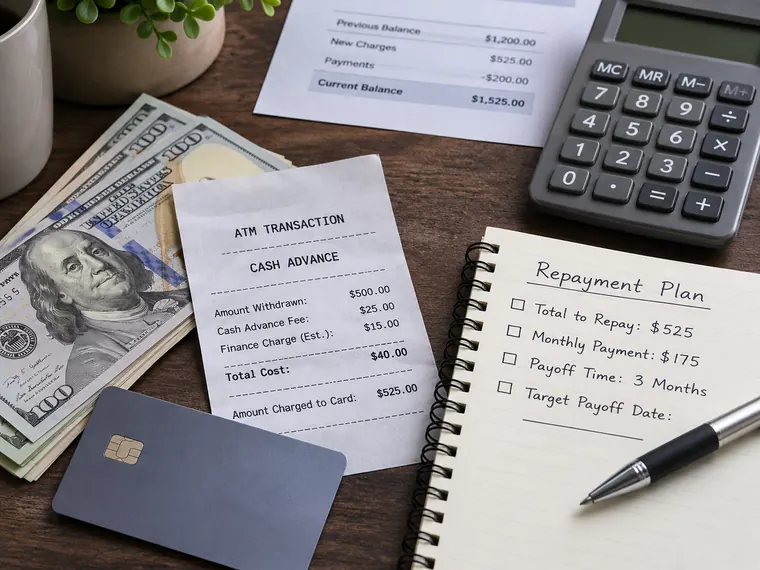
When the need is urgent, the immediate cash can matter more than next month’s statement. Before you withdraw, check whether another option could cover the expense at a lower total cost.
Ask the biller for an extension or installment arrangement first: find out the total fee, due dates and any consequences of late payment. If you have accessible savings, check how using them would affect your emergency cushion. A bank or credit union loan may be an alternative if the total fees and interest are lower and you can meet the repayments. If you’re already struggling with required card payments, contact your issuer about hardship options. Our late payment calculator can help estimate the potential cost of delaying a card payment instead of assuming another cash advance is cheaper.
Do not sacrifice essentials to pay off an advance sooner. Check the timing of the bills that come due before you expect to repay, and keep required payments current where possible.
Cash advance calculator FAQs
How much would a $1,000 cash advance cost?
With a hypothetical 5% fee, 29.99% APR, interest on the $1,050 card balance and 30 interest-bearing days on a 365-day basis, the fee is $50 and interest is about $25.88. Total cost is $75.88, excluding additional charges. Enter your own card terms for a personalized estimate.
Does a cash advance start charging interest immediately?
Generally, cash advances do not receive the purchase grace period. Check whether your card begins charging interest on the transaction or posting date.
How much cash can I get from a $10,000 credit card?
Your issuer may set a separate cash advance limit that is lower than your overall credit limit. Available credit and ATM withdrawal limits can also restrict the amount. Check your account or ask your issuer; this calculator does not estimate eligibility.
Is the cash advance fee the same as APR?
No. The fee is generally an upfront charge, while APR represents the annual interest rate. Both affect the amount you repay. A minimum fee can make small withdrawals relatively expensive.
Can I make extra payments to reduce cash advance interest?
Earlier payments can reduce the outstanding balance and therefore subsequent interest, but the amount actually applied to the advance depends on your account’s payment allocation rules. This calculator models one full repayment, not an installment schedule.
Will paying the balance by the statement due date avoid cash advance interest?
Generally no. The normal purchase grace period does not usually apply to advances. Ask your issuer for the payoff amount and whether additional interest will appear on the next statement.
Does this tool calculate payday loans or merchant cash advances?
No. It is designed specifically for a single consumer credit card cash withdrawal, not payday advances, installment loans or merchant financing.